Software
I develop scientific software of two kinds. The Python libraries solve families of Hamiltonians (tight-binding models, spin models) and can be used from any other Python code. The interactive programs are built on those libraries, so that a calculation can be set up by changing parameters in a window rather than by writing a script.
Everything is released under the GPL and is free to use in any project. Most of it is still under active development.
pyqula
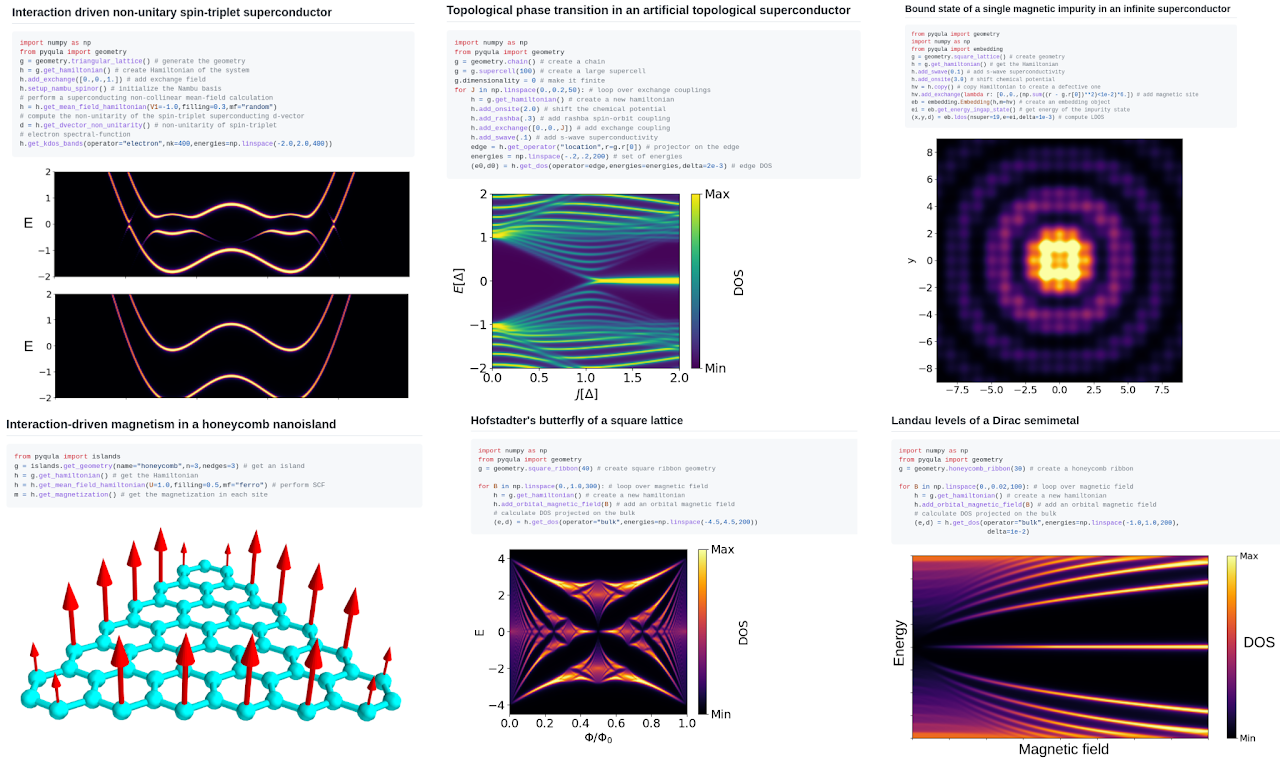
Tight-binding models on quantum lattices, in any dimension: band structures, Fermi surfaces, spectral functions, topological invariants, mean-field interactions, superconductivity and non-collinear magnetism, with a few lines of Python each.
GitHub · pip install pyqula
dmrgpy
Quantum many-body models with matrix product states, built on the ITensor library: ground states, excited states, and static and dynamical correlators of spin and fermionic chains.
GitHub · pip install dmrgpy
Quantum Lattice
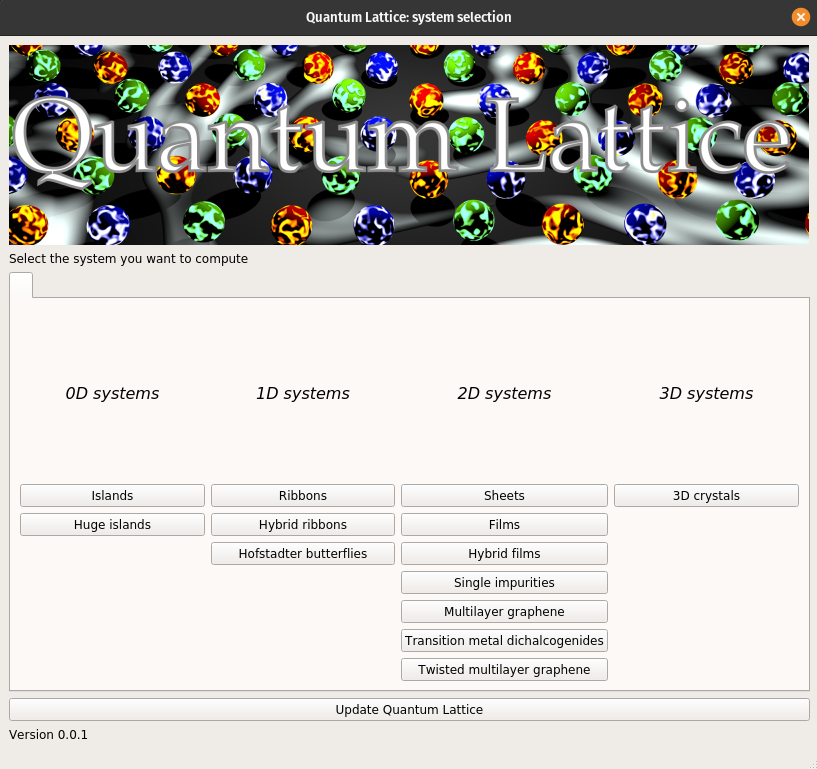
Tight-binding models, computed interactively: band structures, Fermi surfaces, spectral functions, topological invariants, local magnetization and local density of states, for systems with non-collinear magnetism, spin-orbit coupling, superconductivity and electronic interactions. Built on pyqula.
GitHub · Example session (video)
SpinFlare
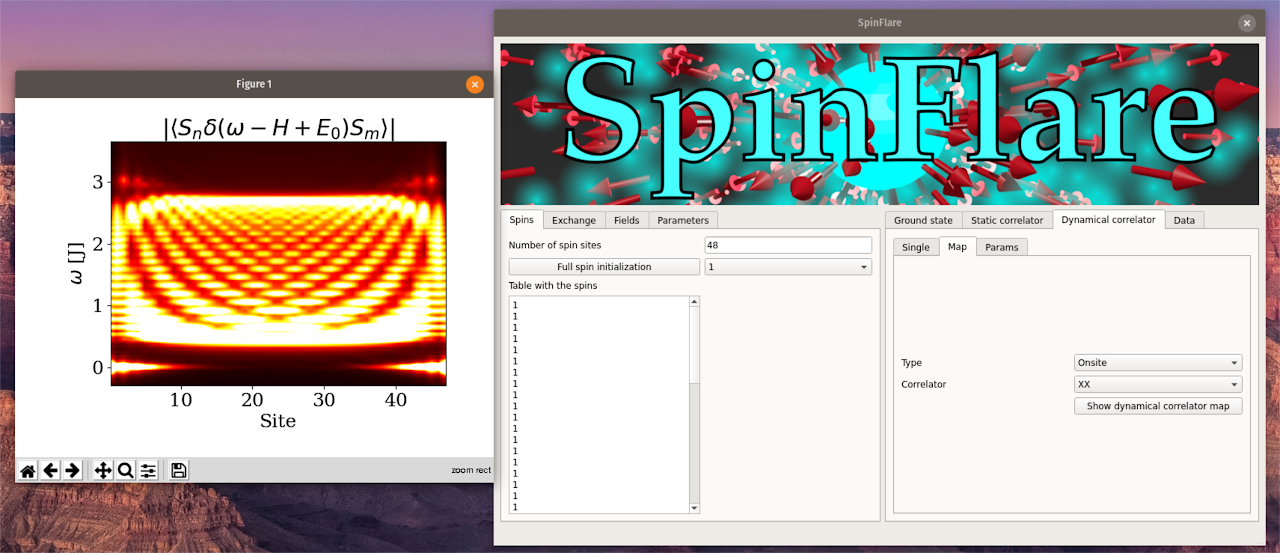
One-dimensional quantum many-body spin Hamiltonians, solved interactively with matrix product states: ground state magnetization, static and dynamical spin-spin correlators, and excited states. A chain of 100 quantum spins takes a few seconds.
Qutranpy
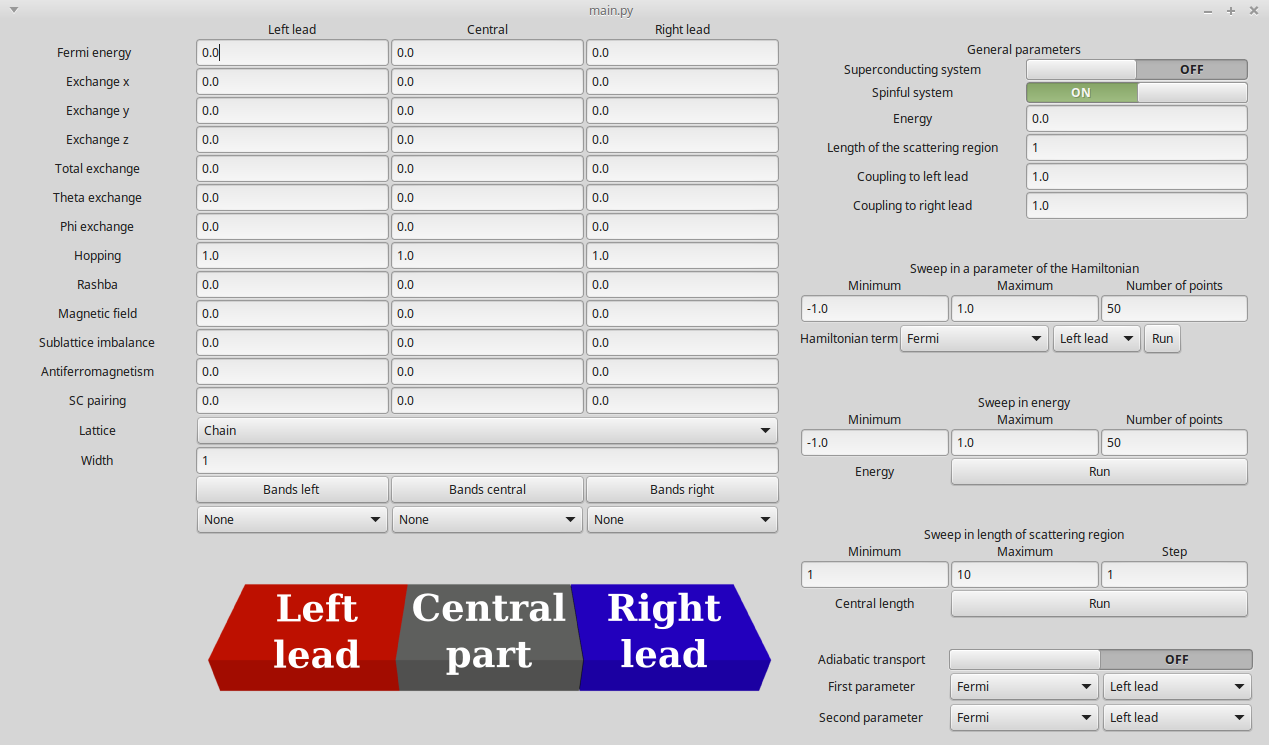
Quantum transport in a two-terminal geometry, with the Landauer and scattering matrix formalism. The Hamiltonians of the leads and of the scattering region can each be given exchange fields, a mass term, spin-orbit coupling or superconductivity. Built on the pygra library.
Tranci
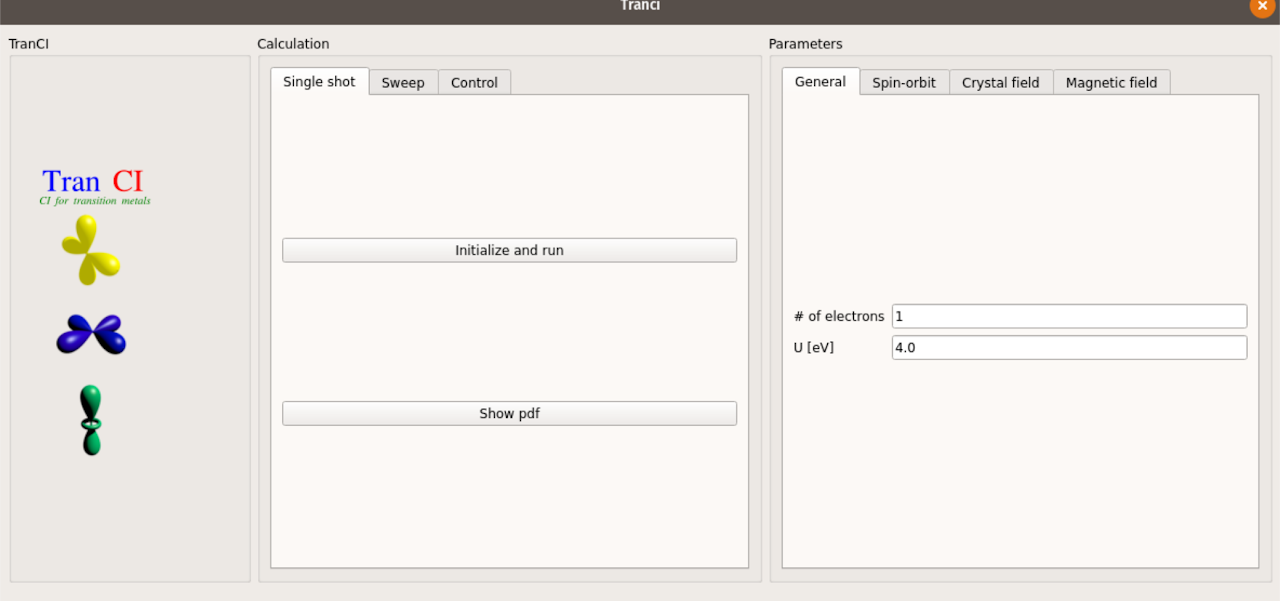
Electronic properties of transition metal atoms on surfaces, solved in the full many-body space of the d orbitals with the configuration interaction method, including crystal fields, spin-orbit coupling and electronic interactions. The results are written to a PDF: the operators projected onto the ground state manifold, the eigenstates, and how the levels evolve with each parameter.
Python libraries
pyqula
Tight-binding models on quantum lattices, in any dimension: band structures, Fermi surfaces, spectral functions, topological invariants, mean-field interactions, superconductivity and non-collinear magnetism, with a few lines of Python each.
GitHub · pip install pyqula
dmrgpy
Quantum many-body models with matrix product states, built on the ITensor library: ground states, excited states, and static and dynamical correlators of spin and fermionic chains.
GitHub · pip install dmrgpy
Interactive programs
Quantum Lattice
Tight-binding models, computed interactively: band structures, Fermi surfaces, spectral functions, topological invariants, local magnetization and local density of states, for systems with non-collinear magnetism, spin-orbit coupling, superconductivity and electronic interactions. Built on pyqula.
GitHub · Example session (video)
SpinFlare
One-dimensional quantum many-body spin Hamiltonians, solved interactively with matrix product states: ground state magnetization, static and dynamical spin-spin correlators, and excited states. A chain of 100 quantum spins takes a few seconds.
Qutranpy
Quantum transport in a two-terminal geometry, with the Landauer and scattering matrix formalism. The Hamiltonians of the leads and of the scattering region can each be given exchange fields, a mass term, spin-orbit coupling or superconductivity. Built on the pygra library.
Tranci
Electronic properties of transition metal atoms on surfaces, solved in the full many-body space of the d orbitals with the configuration interaction method, including crystal fields, spin-orbit coupling and electronic interactions. The results are written to a PDF: the operators projected onto the ground state manifold, the eigenstates, and how the levels evolve with each parameter.